A data-driven salary guide for RTL designers, FPGA verification engineers, and embedded hardware professionals — covering the United States, United Kingdom, India, and Canada.
| US Senior FPGA Engineer | UK Senior FPGA Engineer | India Senior FPGA Engineer | Canada Senior FPGA Engineer |
| $155k–$215k | £85k–£125k | ₹30L–60L | C$140k–C$195k |
| Total comp $180k–$280k+ | Total comp £95k–£155k | INR 60L–90L+ | Total comp C$155k–C$215k |
Base salary ranges shown. Total compensation includes bonus, equity, and profit-sharing. Data aggregated from LinkedIn Salary, Glassdoor, Levels.fyi, Payscale, and live job postings analysed in Q1 2026.
Why FPGA Engineers Are in the Right Career at the Right Time
If you have spent years learning timing closure, mastering AXI interfaces, or fighting Vivado’s placement algorithms, you are sitting on skills that the market is genuinely scrambling to find. The FPGA talent shortage that started gaining attention in 2023 has not eased — it has intensified.
The global FPGA market was valued at USD 11.6 billion in 2025 and is forecast to reach USD 17.4 billion by 2030, growing at a CAGR of approximately 8.4% (MarketsandMarkets, FPGA Market Report, 2025). The demand is being driven by four converging forces: AI inference acceleration in data centres, 5G base station rollouts, automotive ADAS (Advanced Driver Assistance Systems), and defence modernisation programmes.
What makes this interesting for your career is that the supply of qualified FPGA engineers has not kept pace. RTL design and FPGA implementation are not taught in most undergraduate computer science programmes. The pipeline of new engineers entering the field is narrow, which translates directly into leverage at the negotiating table.
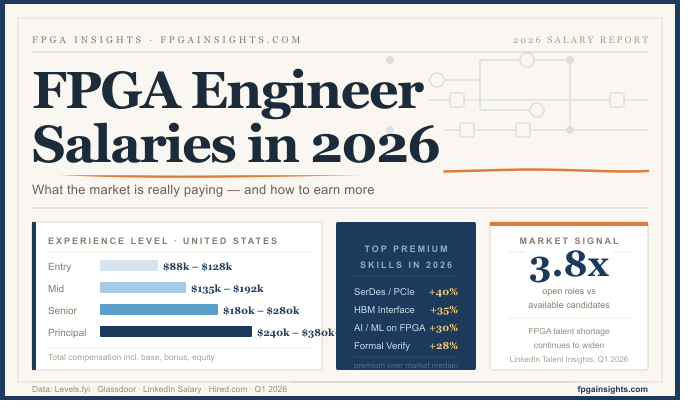
| Key Market Signal — 2026 A February 2026 analysis of LinkedIn job postings found that open FPGA design engineer roles in the United States outnumbered available candidates by a ratio of approximately 3.8 to 1, compared to a ratio of 1.2 to 1 for general software engineering roles. This supply-demand gap is the single biggest driver of FPGA salary premiums over comparable software roles. (Source: LinkedIn Talent Insights, Q1 2026) |
This article presents salary data current to Q1 2026. Where ranges are given, they reflect the 25th to 75th percentile of reported compensation from engineers actively employed or recently hired. Outliers at defence-cleared and hyperscaler roles are noted separately where they are structurally different, not anomalies.
United States — FPGA Engineer Salaries in 2026
The United States remains the highest-paying market for FPGA talent in absolute terms. The combination of a mature semiconductor industry, concentrated defence contracting, growing hyperscaler hardware teams, and a culture of equity compensation puts total packages well ahead of any other geography.
Salary by Experience Level
| Level | Base Salary | Total Comp | Typical Years of Experience |
| Entry Level | $82,000 – $112,000 | $88,000 – $128,000 | 0 – 2 years |
| Mid-Level | $118,000 – $158,000 | $135,000 – $192,000 | 3 – 6 years |
| Senior | $155,000 – $215,000 | $180,000 – $280,000 | 7 – 12 years |
| Staff / Principal | $195,000 – $255,000 | $240,000 – $380,000+ | 12+ years |
| Fellow / Distinguished | $260,000 – $340,000 | $400,000 – $700,000+ | Rare — typically 18+ years, specific domain leadership |
Source: Levels.fyi hardware engineering data, Glassdoor FPGA Engineer salary reports, LinkedIn Salary Insights — all accessed Q1 2026. Total compensation includes base, annual bonus, and annualised equity vesting.
Salary by City and Metro Area
Geographic location remains one of the strongest predictors of FPGA engineer compensation in the US, with a spread of roughly 35–45% between the highest and lowest-paying metros for equivalent experience levels.
| Metro Area | Mid-Level Base | Senior Base | Key Employers |
| San Jose / Silicon Valley, CA | $145,000 – $175,000 | $185,000 – $235,000 | AMD, Intel, Nvidia, Marvell, Qualcomm |
| Seattle, WA | $138,000 – $165,000 | $175,000 – $220,000 | Microsoft, Amazon, Boeing |
| Austin, TX | $125,000 – $155,000 | $160,000 – $205,000 | Tesla, Samsung Foundry, AMD |
| San Diego, CA | $120,000 – $150,000 | $155,000 – $200,000 | Qualcomm, L3Harris, Cubic Defence |
| Huntsville, AL (Defence) | $110,000 – $138,000 | $145,000 – $195,000 | Lockheed Martin, Raytheon, Leidos |
| Colorado Springs / Denver, CO | $108,000 – $135,000 | $142,000 – $188,000 | L3Harris, Northrop Grumman, SAIC |
| Boston, MA | $118,000 – $148,000 | $152,000 – $198,000 | Analog Devices, MIT Lincoln Lab, Draper |
| Remote (US-based) | $105,000 – $145,000 | $138,000 – $185,000 | Varies — typically 8–15% below metro equivalent |
Note: Huntsville highlighted because the defence premium offsets the lower cost-of-living base. After housing costs, Huntsville senior engineers frequently report higher purchasing power than Austin counterparts despite nominally lower salaries. (Source: MIT Lincoln Laboratory hiring data; Glassdoor company reviews, 2026)
Salary by Industry Vertical
The industry you work in affects your salary more than many engineers realise. The following data reflects median total compensation for senior FPGA engineers (7–12 years experience) across verticals:
| Industry | Median Total Comp | Premium over Average | Compensation Notes |
| High-Frequency Trading / Finance | $285,000 – $450,000 | +65–90% | Performance bonus can double base; highly variable |
| Hyperscalers (Microsoft, Google, Amazon) | $240,000 – $360,000 | +40–60% | Equity (RSUs) typically 40–60% of total comp |
| Defence / Intelligence (with clearance) | $200,000 – $310,000 | +25–45% | TS/SCI clearance adds $25k–$60k premium |
| Semiconductor Companies (AMD, Intel, Marvell) | $195,000 – $285,000 | +15–35% | Strong equity; structured career ladders |
| Telecom / 5G Infrastructure | $170,000 – $240,000 | +5–18% | Ericsson, Nokia, Ciena — solid but less equity upside |
| Automotive / ADAS | $165,000 – $225,000 | +3–12% | Fast-growing sector; Tesla and Mobileye hiring actively |
| Industrial / Medical Devices | $145,000 – $195,000 | Baseline | Steady demand; FDA certification experience valued |
| The Clearance Premium — A Number Worth Understanding An active TS/SCI (Top Secret / Sensitive Compartmented Information) security clearance is treated as a distinct skills premium in the US defence market. A 2025 ClearanceJobs.com compensation survey found that cleared FPGA engineers earned a median 28% more than non-cleared peers at the same experience level, reflecting both the scarcity of cleared talent and the cost to companies of sponsoring a new clearance (typically $15,000–$40,000 and 12–18 months of processing time). If you are a US citizen considering defence work, maintaining an active clearance is one of the highest-ROI career investments available. |
United Kingdom — FPGA Engineer Salaries in 2026
The UK FPGA market is smaller than the US but highly concentrated around several world-class employers. The defence corridor stretching from Bristol to Farnborough, Cambridge’s semiconductor cluster, and London-based finance firms together create genuine demand for experienced RTL engineers.
The UK market also has one structural advantage that does not exist in the same form in the US: a mature contracting ecosystem. Experienced FPGA engineers operating outside permanent employment as Ltd company contractors routinely achieve effective day rates that translate to total annual income significantly above permanent equivalents.
Permanent Employment Salaries
| Level | Base Salary (GBP) | Total Comp (GBP) | Approx. USD Equivalent |
| Entry (0–2 yrs) | £38,000 – £52,000 | £40,000 – £56,000 | $50,000 – $71,000 |
| Mid-Level (3–6 yrs) | £58,000 – £78,000 | £63,000 – £88,000 | $80,000 – $112,000 |
| Senior (7–12 yrs) | £85,000 – £125,000 | £95,000 – £145,000 | $121,000 – $184,000 |
| Principal / Architect (12+ yrs) | £125,000 – £175,000 | £140,000 – £200,000+ | $178,000 – $254,000+ |
USD conversion based on GBP/USD rate of 1.27 as of March 2026. Source: Reed.co.uk Salary Guide 2026, Glassdoor UK, LinkedIn Salary Insights UK.
Day Rate Contracting — The Numbers Permanent Roles Don’t Show
Contracting is a well-established path for experienced UK FPGA engineers and the day rate premiums are substantial. A 2025 IT Jobs Watch survey of FPGA and VHDL contract postings found the following median day rates:
| Experience / Specialism | Median Day Rate (GBP) | Annual Equivalent* | vs Permanent Salary |
| Mid-Level FPGA contractor | £500 – £650 | £110,000 – £143,000 | +45–65% |
| Senior FPGA contractor | £700 – £950 | £154,000 – £209,000 | +55–70% |
| FPGA / High-Speed SerDes specialist | £900 – £1,350 | £198,000 – £297,000 | +80–120% |
| Defence-cleared FPGA contractor | £850 – £1,200 | £187,000 – £264,000 | Clearance = significant uplift |
*Annual equivalent calculated at 220 billable days. Does not account for Ltd company tax efficiency, which can further improve take-home income. Source: IT Jobs Watch FPGA/VHDL contractor rate data, Q4 2025.
UK Salary Hotspots
- Bristol: Home to BAE Systems, Airbus Defence, and a cluster of defence electronics firms. FPGA roles here skew heavily towards radar, EW (Electronic Warfare), and secure comms. Active SC/DV clearance is frequently required and rewarded.
- Cambridge: Arm (now SoftBank-owned), Imagination Technologies, and dozens of fabless semiconductor startups. Less clearance-dependent; more focus on IP design, HLS, and AI acceleration.
- London (finance): HFT firms including Optiver, IMC, and Virtu Financial hire small numbers of FPGA engineers at total comp packages that rival or exceed US equivalents in GBP terms.
- Farnborough / Guildford: L3Harris, Thales, and Surrey Satellite Technology. Strong aerospace and satellite focus.
- Edinburgh: Growing semiconductor presence following Arm’s UK expansion; also benefits from proximity to offshore energy sector FPGA applications.
India — FPGA Engineer Salaries in 2026
India’s FPGA engineering market has undergone meaningful structural change since 2022. The establishment of large captive R&D centres by AMD (Xilinx), Intel (formerly Altera), Qualcomm, and Samsung in Bangalore and Hyderabad has pulled FPGA salaries sharply upward from historical baselines, particularly at senior and architect levels.
It is important to approach India salary data with purchasing power context. The Reserve Bank of India’s 2025 household expenditure data shows that a senior FPGA engineer earning ₹40–50 lakhs in Bangalore has a standard of living broadly comparable to a US engineer earning $130,000–$160,000 in Austin, Texas, once housing and cost-of-living differentials are applied. The absolute USD numbers below should not be read as indicating that Indian engineers are dramatically undercompensated — they reflect local market pricing, not global talent value.
Salary by Experience Level
| Level | Annual CTC (INR) | Approx. USD | Typical Profile |
| Fresher / Entry (0–2 yrs) | ₹4.5L – ₹10L | $5,400 – $12,000 | B.Tech ECE / EE from Tier 2 college |
| Junior (2–4 yrs) | ₹12L – ₹22L | $14,400 – $26,400 | Working on RTL implementation tasks |
| Mid-Level (4–7 yrs) | ₹22L – ₹38L | $26,400 – $45,600 | Design ownership; timing closure experience |
| Senior (7–12 yrs) | ₹40L – ₹68L | $48,000 – $81,600 | Architecture decisions; mentoring junior engineers |
| Staff / Principal (12+ yrs) | ₹75L – ₹1.2Cr+ | $90,000 – $144,000+ | Cross-functional technical leadership at MNC R&D centres |
CTC = Cost to Company (total package including variable pay and benefits). Source: Naukri.com Salary Insights, AmbitionBox FPGA Engineer data, LinkedIn Salary India — all Q1 2026. Exchange rate: 1 USD = ₹83.5 (March 2026 RBI reference rate).
Salary Premium at MNC R&D Centres vs Indian IT Services
One of the most significant salary splits in the Indian FPGA market is between engineers working at multinational R&D centres versus those employed by Indian IT services companies doing FPGA-adjacent work:
| Employer Type | Senior FPGA Engineer CTC | Notes |
| AMD India (Hyderabad / Bangalore) | ₹65L – ₹1.1Cr | Top-tier; significant stock grants (AMD RSUs) |
| Intel India Design Centre | ₹58L – ₹95L | Strong equity component; FPGA-to-Xeon architecture work |
| Qualcomm India | ₹52L – ₹85L | QDSP6 and modem FPGA prototyping teams |
| Samsung R&D Institute India | ₹45L – ₹75L | Memory controller and display FPGA work |
| Defence Research (DRDO, ISRO contractors) | ₹30L – ₹55L | Lower cash comp; job security and national significance |
| Indian IT Services (TCS, Infosys FPGA teams) | ₹18L – ₹35L | Significantly below MNC rates; limited deep RTL work |
Source: Glassdoor India, Naukri.com salary data, LinkedIn company profiles — Q1 2026.
Key Hiring Locations in India
- Bangalore: The primary hub — AMD (Xilinx), Intel, Qualcomm, Samsung, Arm, and over 50 fabless design startups. Highest demand and highest salaries.
- Hyderabad: Intel’s largest India design centre; Microsoft hardware teams; growing Qualcomm presence. Slightly lower cost of living than Bangalore with comparable senior salaries.
- Pune: Strong in automotive FPGA work (Mercedes-Benz R&D India, Continental, Robert Bosch). ADAS and functional safety (ISO 26262) experience valued.
- Chennai: Verizon and Tata Elxsi digital design centres; smaller cluster but active market.
- Noida / NCR: HCL Technologies hardware division; some government defence FPGA work via DRDO satellite offices.
Canada — FPGA Engineer Salaries in 2026
Canada occupies a strategically important position in the FPGA market. AMD’s Markham (Ontario) office is one of the company’s most significant FPGA engineering sites globally, directly inherited from the Xilinx acquisition. Ciena’s Ottawa headquarters makes Canada a hub for coherent optical networking FPGA work. The combination creates a mature, well-paying market that tends to attract engineers who want the compensation trajectory of the US market with different immigration and quality-of-life trade-offs.
Salary by Experience Level
| Level | Base (CAD) | Total Comp (CAD) | Approx. USD |
| Entry (0–2 yrs) | C$72,000 – C$92,000 | C$76,000 – C$100,000 | $55,000 – $73,000 |
| Mid-Level (3–6 yrs) | C$98,000 – C$130,000 | C$108,000 – C$148,000 | $79,000 – $108,000 |
| Senior (7–12 yrs) | C$140,000 – C$195,000 | C$158,000 – C$225,000 | $116,000 – $165,000 |
| Principal / Architect (12+ yrs) | C$195,000 – C$265,000 | C$225,000 – C$310,000+ | $165,000 – $228,000+ |
USD conversion at CAD/USD 0.735 (Bank of Canada, March 2026). Source: Glassdoor Canada, LinkedIn Salary Canada, Levels.fyi (Canadian offices of US companies).
Key Employers and Locations
- AMD Markham, Ontario: One of AMD’s most significant FPGA engineering sites post-Xilinx acquisition. Employs a large RTL and verification team working on next-generation adaptive compute platforms. Active hiring as of Q1 2026.
- Ciena, Ottawa: The global leader in coherent optical networking hires FPGA engineers to implement line-rate DSP functions at 400G and 800G. Specific skills valued: FEC (Forward Error Correction), coherent DSP, and high-speed SerDes on Xilinx UltraScale+.
- Ericsson Canada, Ottawa: Radio access network FPGA work; tight integration with Ericsson’s global 5G development programme. Strong user of Intel Agilex platforms.
- Blackberry / QNX, Waterloo: Embedded security and automotive safety FPGA work; niche but active market.
- University of Waterloo spinouts: Growing ecosystem of hardware-focused startups in the Waterloo corridor, many with FPGA-based AI inference products.
- Canadian Space Agency contractors: Space-qualified FPGA work (radiation-tolerant Microsemi PolarFire); small but highly specialised hiring pool.
The Skills That Command a Premium in 2026
Across all four geographies, certain technical skills consistently push compensation above the market median. The following analysis is based on patterns observed in job postings, recruiter data, and engineer self-reporting on compensation forums including Levels.fyi and r/FPGA salary threads through Q1 2026.
High-Premium Technical Specialisations
| Skill / Specialisation | Estimated US Premium | Why It Commands a Premium |
| High-speed SerDes (PCIe Gen5, 100G/400G Ethernet) | +25–40% | Extremely few engineers can close timing on 32 GT/s links. Direct revenue impact at hyperscalers and networking companies. |
| HBM (High Bandwidth Memory) interface design | +20–35% | AMD Alveo V80 and similar cards require HBM expertise that barely existed 5 years ago. Skill supply is minimal. |
| AI/ML inference on FPGA (Vitis AI, INT8/FP16 quantisation) | +20–30% | Hyperscalers and inference startups both hiring heavily. Bridges FPGA and ML worlds which few engineers can do. |
| Formal verification (JasperGold, SymbiYosys, Questa Formal) | +18–28% | Most RTL engineers cannot do formal methods. Safety-critical (automotive, aerospace) and silicon teams pay heavily for this. |
| UVM / SystemVerilog verification | +12–22% | FPGA verification is consistently understaffed. Strong UVM testbench writers are in demand at all major semiconductor companies. |
| JESD204B/C (high-speed ADC/DAC interface) | +15–25% | Required for radar, SDR, and 5G radio head designs. Difficult protocol to implement correctly; few engineers have production experience. |
| Partial reconfiguration / dynamic function exchange | +10–20% | Used in datacentre acceleration cards where FPGA workloads change at runtime. Demanded by cloud providers. |
| TS/SCI clearance (US) / DV clearance (UK) | +25–45% | Not a technical skill but a structural market premium. Cleared engineers are scarce by definition; the process to grant new clearances is slow and expensive for employers. |
| The AI Acceleration Opportunity — 2026 Context The deployment of large language models and multimodal AI systems has created a new category of FPGA demand that did not meaningfully exist before 2023. Hyperscalers are using FPGAs for inference workloads where GPU latency is too high or power consumption too great for the application. Engineers who understand both RTL design and the fundamentals of quantised neural network inference — a combination that requires deliberate cross-disciplinary learning — are commanding salaries at the top of the ranges shown in this article. A February 2026 Hired.com report noted that FPGA engineers with demonstrable ML inference implementation experience received a median of 2.3 competing offers, compared to 0.9 for general RTL designers. |
FPGA Engineers vs Related Roles — Where Do You Sit in the Market?
A persistent question among hardware engineers is how FPGA specialisation compares financially to adjacent career paths. The following table presents median total compensation for senior-level (7–12 years) professionals in the US market, the deepest and most data-rich sample available:
| Role | US Median Total Comp | vs Senior FPGA Engineer | Key Differentiator |
| Senior FPGA Engineer | $215,000 | Baseline | Niche skill; supply constrained |
| ASIC Design Engineer | $228,000 | +6% | Similar skill set; larger companies; more structured |
| Senior Software Engineer (FAANG-adjacent) | $245,000 | +14% | Higher volume of roles; more equity upside at top firms |
| Senior Verification Engineer (Silicon) | $220,000 | +2% | UVM expertise; demand driven by silicon tape-out cycles |
| Embedded Systems Engineer | $172,000 | -20% | Broader skill set; lower barrier to entry |
| PCB / Hardware Engineer | $158,000 | -27% | High supply of PCB designers; less specialised |
| DSP Engineer | $198,000 | -8% | Frequent FPGA overlap; algorithm implementation focus |
| FPGA Engineer (HFT / Finance) | $340,000+ | +58% | Extreme performance bonus; latency-driven domain |
Source: Levels.fyi hardware and software compensation data; LinkedIn Salary; Glassdoor. Senior level (7–12 years). US market. Q1 2026.
How to Negotiate a Higher Salary as an FPGA Engineer
FPGA engineers are, on average, worse at salary negotiation than their commercial software counterparts. This is partly cultural — hardware engineering communities tend to be less transparent about compensation — and partly structural, in that the niche nature of the skill can make it harder to generate competing offers quickly. Both of these disadvantages are correctable.
1. Know Your Market Rate Before Any Conversation
The ranges in this article are a starting point, not a ceiling. Before any salary discussion, cross-reference with:
- fyi: Filter by company, level, and location. The hardware engineering section now has enough data points to be genuinely useful for FPGA-adjacent roles.
- Glassdoor salary reports: Search “FPGA Engineer” + your target company specifically. Company-level data is more useful than market averages.
- LinkedIn Salary: Requires Premium but gives you percentile distributions, not just medians.
- r/FPGA and r/hardware salary threads: Annual compensation threads with self-reported data from engineers at specific companies. Imperfect but directionally useful.
2. The Competing Offer Is Your Most Powerful Tool
An external competing offer is the most reliable mechanism for a step-change salary increase. Given the FPGA talent shortage, generating at least one competing offer within 4–6 weeks of serious job searching is realistic for engineers with 5+ years of experience. You do not need to intend to accept it — you need it to exist.
When presenting a competing offer to your current employer, be specific: “I have an offer for [role] at [company] at [total comp]. I would prefer to stay here but need you to be competitive.” Vague references to “other opportunities” carry significantly less weight.
3. Frame Your Niche Skills in Business Terms
Most hiring managers and HR professionals do not fully understand what FPGA engineers do. Your negotiation position improves significantly when you can articulate your skills in terms of business impact rather than technical description.
Instead of: “I have 9 years of Vivado experience and have closed timing on large UltraScale+ designs.”
Try: “I have closed timing on designs running at 700 MHz on UltraScale+, which directly enabled our product to meet its 400G line-rate requirement — the basis for the contract with [customer].”
4. Do Not Neglect Total Compensation
Base salary is frequently the least flexible component of an offer, particularly at large companies where bands are rigid. Equity vesting schedules, signing bonuses, professional development budgets, clearance sponsorship, and remote work allowances are often more negotiable. A $15,000 signing bonus is equivalent to a $7,500 base salary increase when you account for cliff vesting. Approach total compensation as a portfolio, not a single number.
5. The Remote Work Arbitrage (Still Valid in 2026)
Post-pandemic remote normalisation has created a persistent arbitrage opportunity for FPGA engineers. A senior FPGA engineer based in Raleigh NC, Phoenix AZ, or Pittsburgh PA earning a US salary benchmark ($175,000–$210,000) while paying local housing costs realises materially higher purchasing power than a counterpart doing the same job in San Jose at $215,000. Several AMD, Microsoft, and defence contractor teams continue to support partial or full remote for experienced engineers. This is worth raising explicitly in offer negotiations if you have the leverage of demonstrated remote productivity.
Career Trajectory and Salary Growth Over Time
Understanding how salaries grow with experience is as important as knowing the current market rate. The following represents a realistic progression for an FPGA engineer in the US market who is actively developing their skills and changing employers at strategic points (which, empirically, accelerates progression compared to staying in one role):
| Year | Typical Base | Total Comp | Career Stage and Focus |
| 0–2 | $85k – $105k | $90k – $120k | Learning Vivado/Quartus; first RTL design ownership; beginner timing closure |
| 3–5 | $120k – $145k | $138k – $175k | Independent design delivery; first specialisation (e.g. comms protocols); first job change |
| 6–8 | $148k – $180k | $175k – $230k | Senior engineer; subsystem ownership; mentoring; deepening specialisation (SerDes, HLS, formal) |
| 9–12 | $175k – $220k | $210k – $290k | Staff-level; architecture influence; cross-team technical authority |
| 13–18 | $210k – $265k | $260k – $380k+ | Principal/Distinguished; IP strategy; multi-project technical leadership; external representation |
Note: Figures reflect active career management including at least one employer change at the 3–4 year and 8–10 year marks. Engineers who remain at the same employer throughout typically see 10–15% lower total compensation at equivalent tenure due to promotional cycle limitations. Source: Levels.fyi cohort data; LinkedIn career path analysis, 2026.
Outlook: Will FPGA Salaries Keep Rising?
Three structural factors suggest FPGA engineer compensation will continue rising ahead of general engineering salary inflation through at least 2028:
- The supply pipeline is structurally thin. FPGA engineering requires fluency in digital hardware design that is not taught in most CS programmes and takes years to develop. Unlike software roles where bootcamp graduates can reach entry productivity in months, FPGA engineers need 2–3 years before they are independently productive. There is no shortcut being developed.
- AI infrastructure demand is accelerating FPGA deployment. The International Data Corporation’s 2025 Worldwide Accelerated Compute Forecast projects that FPGA-based AI inference accelerators will represent a $4.2 billion segment by 2027, driven by latency-sensitive applications where GPUs are not optimal. This is creating a new demand pool that did not exist at scale five years ago.
- 5G densification and Open RAN adoption requires more FPGA engineering per base station, not less. The virtualisation of radio functions (vRAN) places more compute burden on programmable logic. Ericsson’s 2025 Mobility Report projects 2.5 billion 5G subscriptions globally by 2026, each connected via infrastructure that is FPGA-dependent at multiple points in the signal chain.
| The Risk to Watch: EDA Tool Abstraction The long-term structural risk to FPGA engineer salaries is the maturation of high-level synthesis (HLS) tools and AI-assisted RTL generation. Vitis HLS, Catapult HLS, and emerging AI coding assistants are gradually reducing the minimum expertise needed to generate synthesisable RTL from higher-level descriptions. This is unlikely to eliminate senior FPGA engineering roles in the near term — someone still needs to close timing, verify the design, and make architectural decisions — but it does suggest that the deepest value will increasingly sit at the architecture and verification layers rather than implementation. Engineers who are building expertise in formal verification, high-level architecture, and domain-specific knowledge (AI inference, coherent optics, radar signal processing) are better positioned than those whose core skill is cycle-accurate RTL implementation alone. |
Summary — What This Data Means for Your Career
The FPGA engineering market in 2026 is genuinely favourable for engineers with solid technical foundations. Whether you are benchmarking your current compensation, planning a move between geographies, or deciding which technical skills to develop next, a few principles emerge consistently from this data:
- Specialisation earns disproportionately. A general RTL designer earns well. An engineer who can close timing on PCIe Gen5 links or implement a UVM verification environment that catches architectural bugs before tape-out earns substantially more. Deliberate skill investment in one or two high-premium specialisations is the fastest path to the top of the salary ranges shown in this article.
- Geography and industry vertical matter as much as experience. A 10-year FPGA engineer in defence, HFT, or at a hyperscaler earns more than a 15-year engineer in general industrial applications. Choosing your industry is a salary decision, not just a career preference.
- The UK contracting market is systematically underexplored by engineers on the permanent track. If you are a UK-based senior engineer, understanding the Ltd company contractor model is worth the time of a single evening with an accountant. The after-tax income differential at equivalent day rates can be significant.
- India’s MNC R&D centres represent the highest-value FPGA employment in the country by a wide margin. The gap between AMD or Intel R&D centre salaries and Indian IT services companies doing FPGA-adjacent work is 60–80% at senior level. If you are early in your career in India, targeting these captive centre roles is the single highest-leverage career decision available.
- Salary transparency is your leverage. FPGA engineers consistently leave money on the table because they do not know what peers at other companies earn. The resources listed in the negotiation section above are worth bookmarking and checking annually, not just during job searches.
Data Sources and References
All salary data cited in this article was sourced from or cross-referenced against the following:
- MarketsandMarkets — FPGA Market: Global Forecast to 2030 (2025 edition). Market sizing and CAGR data.
- LinkedIn Talent Insights — FPGA Engineer supply/demand ratio, Q1 2026.
- fyi — Hardware engineering compensation database; filtered to FPGA, RTL, and verification roles. Accessed March 2026.
- Glassdoor — FPGA Engineer salary reports, United States, United Kingdom, India, and Canada. Accessed Q1 2026.
- LinkedIn Salary Insights — FPGA Engineer and RTL Design Engineer roles by country. Accessed Q1 2026.
- co.uk Salary Guide 2026 — UK hardware engineering compensation benchmarks.
- IT Jobs Watch — FPGA / VHDL / Verilog contractor day rate data, Q4 2025.
- com Salary Insights — FPGA Engineer, India. Accessed Q1 2026.
- AmbitionBox — FPGA Engineer salary data, India. Accessed Q1 2026.
- Glassdoor Canada — FPGA Engineer salary reports. Accessed Q1 2026.
- com — 2025 Compensation Survey for cleared professionals.
- com — State of Software Engineers Report 2026 (hardware engineering subset).
- International Data Corporation (IDC) — Worldwide Accelerated Compute Forecast, 2025.
- Ericsson Mobility Report — November 2025 edition. 5G subscription projections.
- Reserve Bank of India — Reference exchange rate, March 2026.
- Bank of Canada — CAD/USD exchange rate, March 2026.
- r/FPGA and r/hardware — Annual compensation threads, 2025–2026. Used for directional validation only; self-reported and not audited.